Dr. Amin Hedayat on Retatrutide: What the Data Shows
Editorially reviewed · Last updated September 8, 2026 · How we review
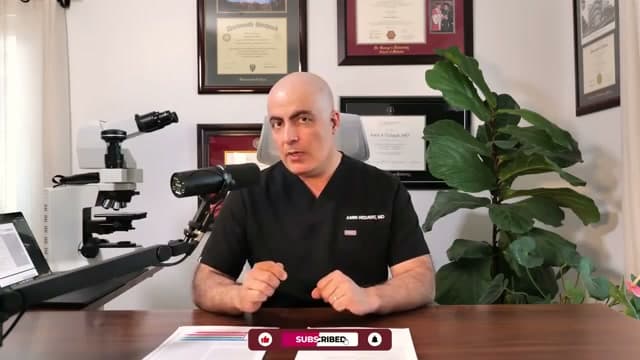
Hedayat states that he has no pharmaceutical affiliations or financial disclosures. This review uses his retrieved transcript and checks the cited research independently: a named citation does not itself establish that a mechanism or safety claim was demonstrated in people.
Does the triple agonist raise energy burn?
Dr. Hedayat describes retatrutide as "the first master key" that targets three receptors — GLP-1, GIP, and glucagon — and explains why adding glucagon is counterintuitive:
"For decades, glucagon was considered the enemy of weight loss. Glucagon is the hormone produced by the pancreas that tells the liver to dump sugar in the blood. It functions essentially the opposite of insulin. So why did the manufacturer Eli Lilly put the sugar-raising hormone into the weight loss drug? Because when you stimulate the glucagon receptor simultaneously with GLP-1 and GIP, you unlock a biological state called thermogenesis."
He further claims that this triple mechanism is why the Phase 2 trials showed "an average weight loss of 24.2%."
| Claim | Published Data | Verdict |
|---|---|---|
| Retatrutide is the first triple GLP-1/GIP/glucagon agonist | Retatrutide (LY3437943) is indeed the first triple agonist to reach Phase 3 trials | Accurate |
| Glucagon activation unlocks thermogenesis | Coskun et al. studied retatrutide’s pharmacology and preclinical effects. The human obesity trial does not isolate glucagon’s energy-expenditure contribution or establish mitochondrial uncoupling in treated people | Preclinical rationale; human mechanism not isolated |
| Average weight loss of 24.2% | Phase 2 NEJM trial: -24.2% at the 12mg dose at 48 weeks. Lower doses achieved -22.8% (8mg), -17.1% (4mg), and -8.7% (1mg) | Approximately accurate — 24.2% is the highest dose result, not the trial-wide average |
Does it reduce liver fat in MASLD?
Dr. Hedayat makes two specific claims about retatrutide and fatty liver disease:
"The high-dose group saw their liver fat drop by over 80%. More incredibly, nine out of 10 patients who started their study with clinical fatty liver disease actually had their liver fat levels returned to the normal range by the end of the trial."
He attributes this to the "glucagon-liver axis" — retatrutide forcing the liver to mobilize and burn its own stored fat.
| Claim | Published Data | Verdict |
|---|---|---|
| Liver fat dropped by over 80% | Sanyal et al. (Nature Medicine, 2024): mean relative reduction of -81.4% at 8mg and -82.4% at 12mg at 24 weeks | Accurate |
| Nine out of 10 patients normalized | At 48 weeks, 89% at 8 mg and 93% at 12 mg achieved liver fat below 5%; the 79% and 86% figures were at 24 weeks. Fewer participants had MRI measurements at 48 weeks | Approximately accurate for the 48-week analysis |
| Glucagon-liver axis drives the effect | The substudy tested retatrutide as a whole and cannot isolate glucagon’s contribution. MRI fat normalization does not establish reversal of fibrosis or a cure for MASH | Mechanism not isolated; endpoint needs qualification |
Does it raise resting heart rate?
This is where Dr. Hedayat makes his most striking risk claims:
"On the 12mg dose, heart rates increased by an average of 7 to 10 beats per minute. The glucagon receptor is located in your heart's natural pacemaker, the sinoatrial node. You're essentially redlining the engine. If your heart normally idles at 70 beats per minute, it's now idling at 80. That's an extra 14,000 heartbeats a day."
| Claim | Published Data | Verdict |
|---|---|---|
| Heart rates increased 7-10 bpm at 12mg | Phase 2 NEJM trial: peak increase of approximately 6.7 bpm at week 24 (12mg dose), declining toward baseline by weeks 36-48 | Overstated — published peak is ~5-7 bpm, not 7-10 bpm |
| Glucagon receptor is on the sinoatrial node | Merino et al. studied isolated rat right atria and found higher glucagon-receptor transcripts in the sinoatrial node. This is not direct evidence of retatrutide’s mechanism in the human heart | Animal evidence; human attribution unproven |
| Extra 14,000 heartbeats per day | This extrapolates a constant 10 BPM increase across a day. A trial mean varies with dose and time and does not establish that individual daily burden or exercise-equivalent strain | Illustration, not a measured clinical outcome |
Phase 2 reported a dose-dependent heart-rate increase that peaked at 24 weeks and subsequently declined. An increased pulse is not itself proof of cumulative heart damage or the equivalent of running a daily half marathon. Long-term cardiovascular evidence must come from outcomes studies.
Does it cause muscle wasting?
Dr. Hedayat identifies muscle wasting as his biggest concern:
"When you lose weight at a speed of about 2% of your body weight per month, your body enters an emergency catabolic state. You not only burn fat but also cannibalize muscle. If you lose 60 lbs but 20 pounds of that is muscle, you have fundamentally lowered your basal metabolic rate."
He recommends 1.2 to 1.5 grams of protein per kilogram of body weight, with specific attention to leucine as "the molecular on-switch for muscle synthesis."
| Claim | Published Data | Verdict |
|---|---|---|
| Rapid weight loss triggers catabolic muscle breakdown | Weight loss can include lean mass, but this trial does not establish a 2%-per-month threshold that triggers an emergency catabolic state | Specific threshold unproven |
| One-third of weight loss could be muscle | The published retatrutide DXA substudy involved type 2 diabetes at 36 weeks. Lean mass is not muscle alone, and it does not validate the hypothetical 20 lb of muscle loss | Confuses lean mass with skeletal muscle |
| Protein 1.2-1.5 g/kg for preservation | The transcript presents this as a research range and advises individual assessment. No retatrutide trial validates a universal protein target or leucine regimen | General nutrition discussion, not a retatrutide-tested protocol |
| Leucine is the on-switch for muscle synthesis | Leucine activates mTORC1 signaling, the primary pathway for muscle protein synthesis. This is well-established in nutritional biochemistry | Accurate |
Does it cause anhedonia?
Dr. Hedayat addresses a side effect that is increasingly discussed but rarely covered in clinical trial reporting:
"There is a deeper side effect — feeling flat and losing interest in the things you used to enjoy. This is called anhedonia. It happens because retatrutide targets receptors in the nucleus accumbens, which is the reward center of the brain. It turns down the volume on dopamine. Everything from the spark of your hobbies to the reward of your morning coffee gets flattened into a grayscale existence. You've silenced the food noise, but you've also dampened the life noise."
| Claim | Published Data | Verdict |
|---|---|---|
| GLP-1 agonists target the nucleus accumbens | Preclinical GLP-1 research involves reward pathways. This does not establish that retatrutide suppresses enjoyment of hobbies or produces anhedonia in humans | Preclinical evidence does not establish the clinical claim |
| Retatrutide causes anhedonia | Anhedonia was not a reported endpoint in TRIUMPH trials. However, anecdotal reports of emotional blunting are widely discussed in GLP-1 user communities, and mechanistic evidence supports the possibility | Not established for retatrutide |
| Retatrutide turns down dopamine | Animal reward-circuit findings cannot establish the direction or magnitude of a human retatrutide dopamine effect. Amplification by glucagon is unproven | Unproven extrapolation |
How can those risks be reduced?
Dr. Hedayat outlines three mitigation strategies for patients considering retatrutide:
The transcript appropriately says to discuss nutrition and medication decisions with the medical team. These suggestions do not constitute a validated retatrutide risk-prevention protocol, and monitoring cannot establish the safety of an unapproved product.
What did the pathologist conclude?
Dr. Hedayat concludes with a balanced assessment:
"Scientifically, retatrutide is a masterpiece in molecular engineering. In the studies thus far, it's shown to improve the fatty liver crisis and the obesity epidemic. But it's a tool of extreme power and it should be respected and approached wisely. While weight loss medications can help fix the biological signal, you should be actively using your lifestyle to build a structure that lasts a lifetime."
How accurate were the claims?
The receptor targets and liver-fat results have clinical support. The major limitations are extrapolating animal mechanisms to humans, presenting lean mass as muscle, and treating anhedonia or cumulative heart damage as established effects.
| Category | Claims | Assessment |
|---|---|---|
| Mechanism of action | Triple agonist, glucagon paradox, thermogenesis | Receptor targets supported; thermogenesis mechanism needs species qualification |
| Liver fat data | 80%+ reduction, 9/10 normalized | Supported with timepoint: 82.4% relative reduction at 24 weeks; 93% below 5% at 48 weeks at 12 mg |
| Heart rate data | 7-10 bpm increase, SA node mechanism | Heart-rate increase supported; rat SA-node data do not establish human mechanism |
| Muscle wasting | Catabolic state, protein/leucine recommendations | Lean mass is not muscle; no validated emergency catabolism threshold |
| Anhedonia | Nucleus accumbens, dopamine dampening | Not established for retatrutide; animal mechanisms are not clinical proof |
| Grey market warning | Zero guarantee of purity, sterility, or potency | Accurate — consistent with FDA enforcement actions |
Several claims need more than a numerical correction. The study’s 48-week liver-fat normalization result supports his “nine out of ten” description. Conversely, the proposed cardiac and dopamine mechanisms are not proven human effects, and a pulse increase is not evidence of accumulating injury.
Frequently Asked Questions
Frequently Asked Questions
Is Dr. Amin Hedayat a real doctor?
Yes. Dr. Amin Hedayat is a triple board-certified physician and pathologist, and an assistant clinical professor. He states in the video that he has no financial disclosures or pharmaceutical affiliations.
Does retatrutide really cause anhedonia?
A causal relationship has not been established. Preclinical GLP-1 reward-circuit studies do not prove that retatrutide causes emotional blunting in humans. FDA’s 2026 psychiatric review is reassuring for the GLP-1 drugs assessed, but is not a dedicated retatrutide anhedonia study. Report new or worsening symptoms to a clinician.
How much does retatrutide increase heart rate?
The Phase 2 trial showed a peak increase of approximately 5-7 beats per minute at the 12mg dose, peaking around week 24 and declining toward baseline by weeks 36-48. Dr. Hedayat's claim of 7-10 bpm slightly overstates the published data.
Is retatrutide safe for your heart?
The answer is still being studied. TRIUMPH-3’s reported cardiovascular-event estimates had confidence intervals that included no difference, and it was not a definitive outcomes trial. TRIUMPH-Outcomes is evaluating longer-term cardiovascular and kidney events. Better blood pressure or cholesterol does not by itself prove cardiovascular safety or benefit.
Does retatrutide cause muscle loss?
Weight loss can include lean mass. Retatrutide’s published body-composition substudy was in adults with type 2 diabetes over 36 weeks, and lean mass includes more than skeletal muscle. It does not establish that one-third of every person’s weight loss will be muscle or validate a universal protein target.
Sources
-
Lilly. TRIUMPH-2 and TRIUMPH-3 results.
-
Lancet Diabetes & Endocrinology. Retatrutide body-composition substudy.
-
Phase 2 trial: Triple-Hormone-Receptor Agonist Retatrutide for Obesity (NEJM) — Jastreboff AM, et al. Phase 2 obesity RCT showing 24.2% weight loss at 12mg
-
Phase 2a MASLD substudy (Nature Medicine) — Sanyal AJ, et al. Liver fat reduction data showing 82% relative reduction
-
Glucagon receptor agonism and thermogenesis (Cell Metabolism) — Coskun T, et al. Mechanism of triple agonist energy expenditure
-
Glucagon receptors in the sinoatrial node (PLOS ONE) — Merino B, et al. Glucagon receptor findings in isolated rat right atria
-
GLP-1 and dopamine reward pathways (Nature Reviews Drug Discovery) — Knerr PJ, et al. Multi-agonist peptides and CNS effects
-
Dr. Amin Hedayat's original video (YouTube) — Full 16-minute analysis
- What this is
- Educational information, not medical advice. It reports published research — it doesn’t recommend that you use, obtain, or supply anything.
- Regulatory status
- Retatrutide and similar peptides are investigational — not approved by the FDA or any regulator. Semaglutide and tirzepatide are prescription-only medicines, available only through a licensed prescriber.
- Our standard
- Every claim traces to a primary source. We label the strength of evidence and flag estimates as estimates — never as clinical fact.
- No commercial ties
- We don’t sell, supply, or link to suppliers of any medicine, and aren’t affiliated with any manufacturer.
Do not make decisions about your health without consulting a qualified healthcare provider. For trial enrolment, see ClinicalTrials.gov. More on how we review.
Sources
- I'm a Pathologist. Retatrutide is NOT Ozempic. (YouTube)
YouTube
- Phase 2 trial (NEJM)
New England Journal of Medicine
- Phase 2a MASLD substudy (Nature Medicine)
Nature Medicine
 NEJM
NEJM The Lancet
 JAMA
JAMA FDA
FDA ClinicalTrials.gov
Related reading

What Is Retatrutide (GLP-3)?
Eli Lilly’s investigational triple receptor agonist: how it works, what trials show, and why GLP-3 is an informal nickname.

Retatrutide and Fatty Liver Disease (MASLD/MASH)
Phase 2 MRI liver-fat results and their limits: reduced fat is not proof of MASH cure or fibrosis reversal.

Does Retatrutide Cause Muscle Loss?
The DXA substudy measured fat and lean-mass reductions. It does not prove a muscle-sparing effect or establish outcomes for every patient.

Retatrutide (GLP-3) Side Effects & Safety Data (2026)
Separate trial tables for retatrutide GI effects and dysesthesia, with rare-event findings and current safety uncertainties.
Andrew Huberman on Retatrutide: What He Said and What the Data Shows
Huberman called retatrutide 'the peptide that changes everything.' Here's what he said and what the data actually shows.
Keep exploring
Explore all fact checks topics →